
Cedar vs. Douglas Fir: Choosing the Right Wood for Pacific Northwest Construction
When it comes to building in the Pacific Northwest, selecting the appropriate wood species is a critical decision that can significantly impact your project's longevity, cost, and aesthetic appeal. Two timber species dominate the region's construction landscape: Western Red Cedar and Douglas Fir. Each offers distinct characteristics that make them suitable for different applications. Understanding their respective advantages and disadvantages will help you make an informed choice for your next building project.
Western Red Cedar: The Northwest Classic
Advantages
Natural Durability and Rot Resistance Western Red Cedar contains natural oils and compounds that provide exceptional resistance to moisture, decay, and insect damage. This inherent protection makes it an excellent choice for exterior applications where wood is exposed to the Pacific Northwest's notorious wet climate.
Dimensional Stability Cedar exhibits minimal shrinkage and warping compared to many other softwoods. This stability ensures that siding, decking, and trim maintain their appearance and fit over time, reducing maintenance requirements and callbacks.
Workability The species is notably easy to cut, shape, and finish. Its straight grain and relatively soft texture allow for precise joinery and detailed work, making it a favorite among craftsmen for custom applications.
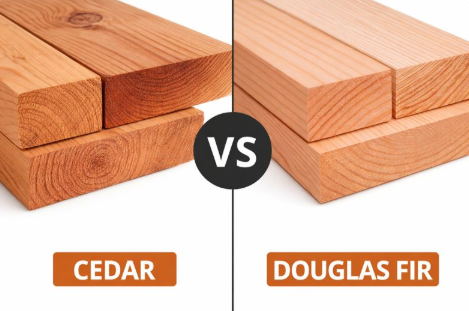
Aesthetic Appeal Cedar's warm, rich tones and attractive grain patterns provide natural beauty that ages gracefully. The silvery-gray patina that develops over time is often considered desirable, particularly for exterior applications.
Disadvantages
Cost Considerations Western Red Cedar typically commands a premium price compared to Douglas Fir, which can significantly impact project budgets, especially for large-scale applications.
Structural Limitations Cedar's lower density translates to reduced strength compared to harder softwoods. It is generally not recommended for primary structural elements such as beams, joists, or load-bearing posts.
Softer Surface The wood's softness makes it more susceptible to dents, scratches, and surface damage, which may be problematic in high-traffic areas or where impact resistance is important.
Douglas Fir: The Structural Powerhouse
Advantages
Superior Strength Douglas Fir is renowned for its exceptional strength-to-weight ratio, making it the preferred choice for structural framing, beams, and engineered wood products throughout the region. Its high density and stiffness provide excellent load-bearing capacity.
Cost Effectiveness Generally more affordable and widely available than cedar, Douglas Fir offers excellent value for structural applications and interior finish work where its strength characteristics are beneficial.
Attractive Grain Douglas Fir features a distinctive, pronounced grain pattern with warm hues ranging from light amber to reddish-brown, making it popular for exposed beams, paneling, and flooring where its natural beauty can be showcased.
Hardness and Durability The wood's density provides good resistance to wear and surface damage, making it suitable for flooring and other applications where durability is paramount.
Disadvantages
Limited Weather Resistance Unlike cedar, Douglas Fir lacks natural rot and insect resistance. When used in exterior applications or moisture-prone environments, it requires proper treatment, sealing, and ongoing maintenance to prevent deterioration.
Dimensional Movement Douglas Fir is more prone to shrinking, swelling, and warping in response to moisture changes. This characteristic requires careful consideration during installation and may necessitate expansion joints in certain applications.
Resin Content The species contains pitch pockets and resin, which can occasionally bleed through finishes, particularly when exposed to heat. This may create aesthetic issues and finishing challenges.
Making the Right Choice
The decision between cedar and Douglas Fir ultimately depends on your specific application:
Choose Western Red Cedar for:
- Exterior siding, trim, and decking
- Applications requiring natural weather resistance
- Projects where dimensional stability is critical
- Aesthetic features where natural aging is desired
Choose Douglas Fir for:
- Structural framing and load-bearing elements
- Interior flooring and exposed beams
- Projects with tighter budget constraints
- Applications requiring maximum strength
Many Pacific Northwest builders leverage the strengths of both species, using Douglas Fir for the structural skeleton and cedar for exterior cladding and trim. This combination approach optimizes performance while managing costs effectively.
Conclusion
Both Western Red Cedar and Douglas Fir have earned their places as premier building materials in the Pacific Northwest. Cedar's natural durability and stability make it ideal for exterior applications and fine detail work, while Douglas Fir's strength and cost-effectiveness establish it as the backbone of structural construction. By carefully evaluating your project's specific requirements—including structural demands, exposure conditions, budget parameters, and aesthetic goals—you can select the species that will deliver optimal performance and lasting value. Working with experienced local contractors familiar with these regional materials will further ensure your project's success in the unique climate of the Pacific Northwest.
1/30/2026